
At Catholic Memorial, students embody true compassion as they learn to lead with their
heart—with myriad opportunities to serve God and society written into the curriculum.
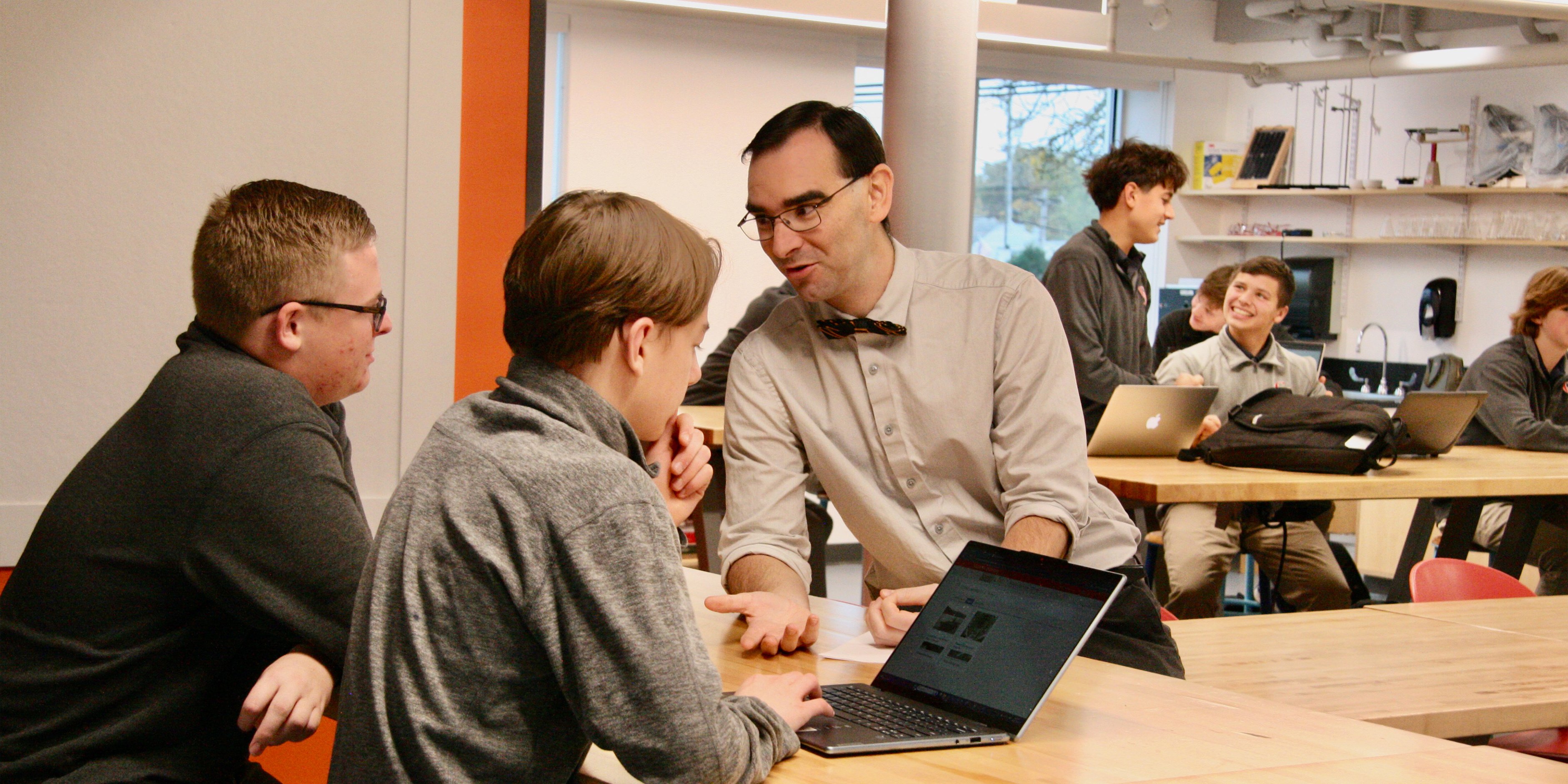
Eighth grade social studies teacher Barbara “Bobbie” Flynn begins each class with prayer intentions—a quiet time for her students to reflect and think about others. They pray for the hungry, the homeless, and the sick. They pray for their own families and those within the Catholic Memorial community—perhaps a classmate who has just had surgery or experienced the loss of a grandparent.
This year’s recipient of the prestigious Harvard Club of Boston Excellence in Teaching Award, presented to outstanding teachers who inspire curiosity and excellence, Flynn encourages boys to lead with their heart, helping shape them into the young men they’ll become—motivated to do good in the world by helping those in need.
“As a mother, I wanted my children to be kind, loving, and considerate of one another and others in society,” says Flynn, the parent of two CM alumni: Jake ’18, a registered nurse at Cincinnati Children’s Hospital Medical Center, and Ryan ’22, who serves in the United States Coast Guard—a career decision he made with former Campus Minister for Christian Service and theology teacher Tabi Arrey. “Both of my boys learned at an early age that service to others is a necessity, and now, they’re living out the mission of Blessed Edmund Rice in their own unique ways. I’m so proud of the men they have become.”
Thankful for the CM faculty, who, she says, helped raise her sons and served as such strong role models over the years, Flynn herself strives to be a positive role model for her own students, both in and out of the classroom.
“I hope they learn from me to be kind. Often, I’ll say to the boys, ‘We only have this one chance on earth, so let’s all try to be kind and considerate of one another,’” Flynn says, noting her continued appreciation for speeches delivered to students by Kevin Durazo, Vice Principal for Grades 9–12 which often conclude with the words, “You know that we love you and care for you.”
Flynn witnessed these words in action amid the coronavirus pandemic in December 2021, when Jake’s former soccer teammates, upon hearing the news that their friend had been involved in a serious car accident, rallied together to record a video of well wishes that they had sent to the hospital. Unable to visit Jake due to visitor restrictions implemented to curtail the virus, they came by to see him frequently once he returned home to help him pass the time as he recovered.
“It was absolutely beautiful,” Flynn recalls. “The CM boy is always present for others in the good times and the bad. He has a heart of gold and is always there to lend a helping hand, to listen, or to get a good laugh from the crowd.”
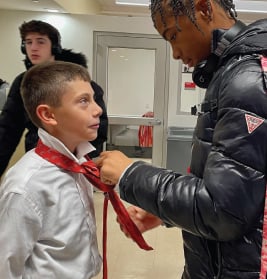 By design, faith formation and robust service expectations—whereby students learn to “lead through service”—are built into CM’s mission. The Campus Ministry Office—a safe, sacred space of faith and community—is situated in the “heart” of the school. And service-learning opportunities, leadership development, and character formation programs prepare students to practice Catholic ideals in service to God and society.
“Helping boys understand that their hearts—their desires, their passions, their dreams—play a profound role in the men they are becoming is vitally important. Just as the physical body does not thrive without a healthy physical heart, our spiritual selves cannot thrive without a healthy spiritual heart,” says Principal and theology teacher Michael “Mickey” Corso, Ph.D. “Our students are transformed by their encounters with those for whom they do service. Learning to live Jesus’ call to ‘love your neighbor as yourself’ as a way of loving and serving God effectively teaches students to lead with their heart. While for some, that experience begins as a transactional fulfillment of a requirement, it rarely ends
there.”
Director of Campus Ministry David Aspinall echoes this sentiment: “Rooted in the Edmund Rice Christian Brothers charism to serve those marginalized by poverty and injustice, our service requirement weaves the practice of helping others into the rhythm of daily life to the point where students seek service and leadership opportunities beyond the requirement itself.”
While at CM, the Flynn brothers participated in numerous Blessed Edmund Rice Solidarity Initiative (BERSI) travel-based immersion programs facilitated by Campus Ministry, learning about the realities of homelessness and helping to serve those less fortunate. Ryan and his classmates would eventually establish Brothers United, a service organization which collected, packaged, and delivered necessities—food, toiletries, socks, and blankets—to homeless shelters throughout Downtown Boston.
“Boys and acts of service come together so effectively, because boys are relational learners and service is a relational practice. Our students are most engaged when they’re able to hear the stories of the people they’re working with and are empowered to use their gifts—their natural sense of compassion and inclination to serve others—to find a solution,” Aspinall explains. “The only way to teach them to lead with their heart is to empower them with active opportunities to do so. This ministry of presence, of encountering ‘Jesus in his most distressing disguises,’ to use the words of St. Teresa of Calcutta, is how boys’ hearts are moved to lead through service.”
Such opportunities have included delivering sandwiches students made to St. Francis House homeless shelter in Downtown Boston, welcoming immigrants at the
United States–Mexico border with open arms, and building houses for families in the impoverished outskirts of Lima, Peru, to name a few.
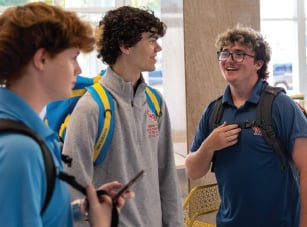 CM students also participate in a wide range of sacramental and contemplative experiences, serving as altar servers, lectors, Eucharistic ministers, ushers, and liturgical choir members at all-school masses and seeking reflection and fellowship at half-day, daylong, and overnight spiritual retreats. Even in the briefest passing moments of the school day, such as a last-minute breakfast before homeroom or the three minute intervals between changing classes, students have been known to congregate in the Campus Ministry Office.
“The mission of our work is helping shape the meaning of masculinity,” Aspinall shares, “where ‘being a man’ means to be a man of compassion, gentleness, and selflessness—the type of manhood the world needs most in our present day.”
Developed by the CM faculty a few years ago, this precise type of manhood building is further exemplified in the Portrait of a Knight, the school’s blueprint for future graduates. As it explains: “A CM graduate is prepared for manhood and the world it brings—a world full of unknown challenges, ambiguity, and complex problems. He appreciates difference, thinks critically and creatively, asks important questions, communicates with clarity, and understands the fundamental value of relationships. He serves his communities with empathy and is confident in his identity and faith.”
CM’s athletics program teaches student-athletes to be not only good sportsmen but good men. Older boys lead by example, treating all teammates—including those who are younger and those who cannot actively participate in the sport—as equals, just as if they were their own brother, sticking up for them and providing ongoing support, guidance, and mentorship.
Varsity head football coach John DiBiaso, who fosters a family-like dynamic on and off the field and never tolerates demeaning behavior or bullying of any kind, recalls one team manager in particular with serious health concerns and physical limitations. DiBiaso’s players embraced their manager as another member of the team, developing close friendships with him and helping to ensure that his high school athletic experience was a positive one. The former manager would go on to be successful in college and beyond, even completing a graduate assistantship tailored to his love of football.
“The qualities needed to be successful in athletics correlate with the qualities needed to be successful in life. Athletics is an extension of the classroom in that the lessons you learn on the athletic field will carry on for the rest of your life,” DiBiaso says. “You’ve got to be disciplined, make a lot of sacrifices, be a team player, and care about others. These qualities become part of student-athletes’ character moving forward, teaching them to contribute to their family as good sons, brothers, husbands, fathers, and grandfathers and their career as good co-workers. I try to instill in them that the whole is more important than the individual—not just in athletics but in every part of their life.”
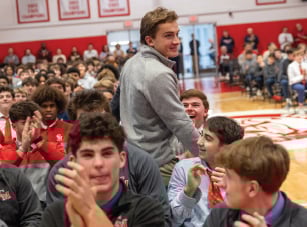 Teammates are together as a group not just for an athletic season but throughout the entire academic year. They take part in conditioning and weightlifting. They participate in the American Cancer Society’s annual Making Strides Against Breast Cancer walk. Under the tutelage of DiBiaso’s wife and CM’s Academic Support Coordinator, Maureen DiBiaso, some volunteer as tutors to younger students as part of their service requirement.
Growing and developing as human beings and not simply football players is especially important, DiBiaso notes, since the vast majority of those who play on his teams will not go on to play college or professional football, instead serving their communities as doctors, lawyers, policemen, firemen, military personnel, teachers, coaches, carpenters, and plumbers. “If they can have a great experience, and learn those important lessons, then I’ve done my job,” says DiBiaso, who has been coaching for more than 40 years. “It’s pretty cool at CM the way all students gravitate toward helping others—and I’m proud of that.”