
During the week of February break, 12 students became immersed in a life of poverty and wealth
disparity in Lima, Peru. CM’s digital content producer Mr. Robbie Moll traveled with this group
and their adult leaders to witness the impact of the Blessed Edmund Rice Service Initiative.
My lungs pulse, searching for their next breath. My legs quiver, sore from the miles they’ve hiked. I wipe the wind-blown sand from my camera lens, hit record, and carry on uphill with the caravan of boys and faculty leaders.
We are in the Andes Mountains, on the brown desert slopes of Jicamarca, a barrio on the outskirts of Lima, Peru. This land is monotone, and color is sparse, found only on painted shacks, family dwellings that are spaces no bigger than where I store my lawnmower.
“I feel a connection to The Road to Emmaus,” says Bryce Concepcion ’26, one of the 12 students marching alongside two faculty leaders and myself up a dirt path. He recalls the story of Jesus appearing to two disciples on a similar desert path, his true identity disguised after his resurrection. “We don’t always recognize that Jesus is with us, but he is,” adds Bryce. Like the Emmaus-bound disciples, we travelers will come away shaped by God’s appearance and through the work we hope to accomplish. The intentional programming of the Blessed Edmund Rice Service Initiative (BERSI) teaches participants how Jesus is as present in the far-off hills of, say, Peru as he is in the everyday familiar of where we live. Through my camera I watch our party assemble on an outdoor patio that will be our home for the next few days. It’s little more than a hundred square feet of concrete, blazing in the afternoon sun. Later, at night, when it’s cool, we will gather around the fire pit after a dinner that will be eaten at a table mere inches from the toilet stalls. For now, we climb to the loft and assemble our bedrooms.
Twenty-four hours earlier, we arrived at Jorge Chávez International Airport on a clear summer night, leaving behind the February snow in Boston. Exiting the plane, we walked into a wall of South American heat. The next morning, roosters crowed throughout the community of Las Flores. Our first view of Peru was lush, bright, and green, drenched in early sunlight. With a backdrop of tawny mountains, Las Flores concealed the nearby desert behind this verdant oasis.
A midday walk took us through a park filled with trees and locals lying beneath their shade. We heard the laughter of children and watched them playing soccer on a cracked, concrete court. Jonny Camargo ’27, being both a varsity soccer forward and Spanish speaker, asked to join their game. To say all parties were delighted would be an understatement.
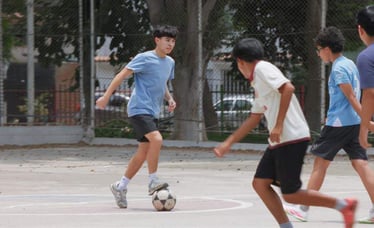 “As soon as I scored a couple goals, they knew I was there to play and have fun,” said Jonny. “They felt comfortable and made me feel comfortable, calling out my name, cheering for me. I saw God, then, in the little connections we made, even for a short time.” The locals played on as the CM boys roared and rattled the chain link fence separating them and the court.
Our first day closed with a tour of the city’s cathedrals. Some hosted Mass in long, gilded halls, others contained modest pews and statues. Most surreal were the catacombs below the Monastery of Saint Francis, where human bones had been piled and arranged into intricate exhibits over the centuries. The boys were charged to reflect on a culture that celebrates death, immediately immersed in a place far different from their own.
Dogs barked as we fell asleep, roosters crowed as we awoke. After a customary breakfast of fruit and bread, we left our suitcases and packed rucksacks… essentials for three days of work in Jicamarca. “You only need one work shirt,” advised Br. Stephen Casey, Director of Immersion for the North America province of the Edmund Rice Christian Brothers and former Catholic Memorial Dean of Students. He would be our host for the week. Tall, broad, and deep-voiced, and at times stern looking until he laughed, Brother Casey was a gentle teddy bear of a man. “You’re going to get dirty one day then get dirty again the next. You might as well wear the same dirty clothes.” We packed as light as we could.
Our journey began on a bus packed like sardines observed by local commuters. Director of Campus Ministry Mr. David Aspinall had taken away all student cell phones at the airport, so boys talked with each other, engaged with strangers in broken Spanish, and watched through the windows as pavement turned to dirt tracks and buildings to shacks.
Twenty bumpy minutes later, we arrived at the neighborhood of Canto Grande. From the bus stop, we hiked uphill with burdensome backpacks for an hour. My camera began recording our approach to the 200-step staircase leading up to Tanya’s house.
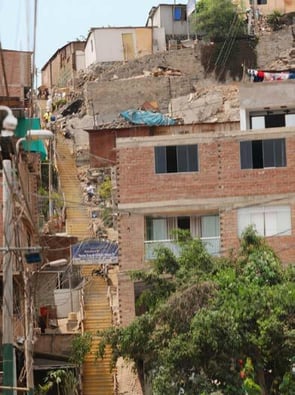 Tanya is a Peruvian woman and friend of the Christian Brothers who welcomes every immersion group into her home to teach them her craft. She makes bracelets, weaving intricate patterns with thin strips of fabric not unlike shoelaces. “How much do they sell for?” asked James Gillespie ’26. “My employer sells them at a rate of two for five soles,” Tanya responded in Spanish, “but they pay me ten cents for each one.” Five soles equal $1.50 USD, of which Tanya takes home three pennies. “People here work so hard, hustling in a way we don’t see back home,” said Jamie Crispi ’26. “It motivates me to think more about my money, to be a better steward of what God has given me.”
Within the walls of her mountain-top shack, the boys sat filling every inch of its largest room. I tucked myself into a side room, a combination of kitchen, bathroom, and bedroom, to film Tanya explaining her craft. In this room I spotted a toy, a Disney princess in a pink dress. I wondered whether it belonged to a child or to Tanya, herself once a child forced by poverty to work instead of playing with dolls. “Look, this is my job, look,” Tanya said, overlapping strips of fabric before the horseshoe of teenagers doing the same, her worn hands guiding the boys as they braided the strings. Departing, we gave hugs and many “gracias!” before hiking down rocky hills to the road. We marched on for countless miles, arriving in Jicamarca where we could finally rest.
Here in the loft at the Christian Brothers’ Jicamarca patio, we set up our bedrooms. Myself, along with Mr. Aspinall and College and Career Counselor Mr. Harry Depuy, are each given a private bedroom. The boys, students ranging from sophomores to seniors, share an empty slab of concrete surrounded by thin, unpainted planks of strand board.
I hear the unloading of mattresses as I take off my backpack, relieved to be relinquishing the film equipment pressing into my shoulders since 7:00 a.m. And to think it’s only noon. Br. Casey’s bellowing voice calls us for lunch.
“The first thing we’re going to do is get water for the house,” says Br. Casey as boys return from clearing the lunch table. “There’s no running water in Jicamarca. You’re going to carry it from the tanks outside and pour it into these buckets to use for your showers and your toilets, alright?” he says in his thick Bronx accent. We look at the two 30-gallon blue plastic drums—and the 50 yards and staircase between them and the 1,000-liter tanks outside. I reach for my camera.
The boys form an assembly line that covers the distance. Mr. Depuy marks one end, waiting by the drums. At the other end is Bryce, eager to take charge, rotating between handing off buckets full of water and receiving empty returns. The tanks’ spouts are operated by Jose Albarran, a bus driver from Jicamarca who first met Br. Casey 20 years ago when he drove the inaugural Catholic Memorial immersion group from the Christian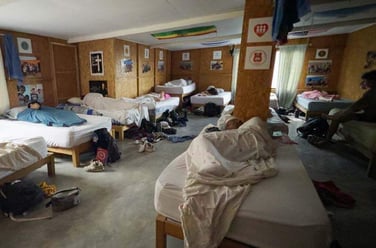 Brothers’ assigned residence in Las Flores to the service work in Jicamarca. Through a daily commute, a fast friendship, a partnership was formed, and it is on Jose’s land, built upon the foundation of his house, where we are now residing: a permanent home in Jicamarca shared by Jose’s family, the Christian Brothers, and the groups they host.
“It’s an immersion, not vacation,” says Nolan Murphy ’28. “I didn’t really know what an immersion was,” continues the group’s youngest member, “but I understand now that we’re here; it’s a whole different world. We’re living out our faith, fully immersing ourselves in what we believe.”
“One more!” shouts a chorus of boys, sending news down the line that the blue plastic drums are nearly full. Br. Casey then explains the water policies. “Water is very expensive for these people, it’s a precious resource,” he says. “The right drum is clean water, you use that for your showers, for washing your hands. The left is greywater. What’s left after a shower goes in here and it’s used again for the toilets, alright?” Needless to say, manual flushing is an immersive experience.
“Giving up everyday comforts like taking a warm shower helps boys stop and thank God for the little things,” says Mr. Aspinall. “We are purposefully drawing ourselves toward marginalized communities,” he continues. “Jesus provided the perfect template for how we should serve others. Through these experiences, we learn to become like Jesus—not just on immersions, but in who we are.”
I replenish my backpack before setting off for the afternoon’s course. We head downhill, then uphill, then downhill, then uphill through the stony streets of Jicamarca to find the home we’ve come to rebuild. At some point along the half-hour trek, Bryce offers to carry my camera. I decline in order to film the journey: as CM’s digital content producer, I’m on the clock.
Our destination is in sight, one of the grey, rusted shacks atop the next hill. I’m with Bryce, Gerry Boudreault ’28, and Ifeanyi Azums ’26. All three are boys I’d filmed for one video or another during my time at CM, but it’s here that I find an opportunity to spend meaningful moments with them. We naturally flock to each other, artists who speak of theater, music, and share in the same lack of stamina, trailing behind the cluster of athletes.
As we regroup, all that stands between us and a water break is two ascending flights of stairs. Even Jonny, the soccer star, struggles to finish. We take in the view from this mid-mountain plateau, and I get the feeling that each of us recognizes the reality of these Peruvians’ lives: that each resident makes this same trek every day… every day.
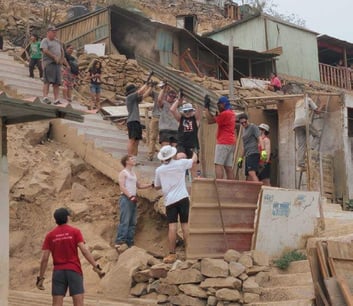 “There’s a lot of mold in the house,” says Br. Casey, introducing us to the service work ahead. “It makes people sick.” This will be a complete tear down of the existing structure before re-building can begin. With that, we meet the family.
Tatiana Priscila Yurima González lives in Jicamarca with her husband and their five children. They moved to Jicamarca from the jungles of Peru when their eldest daughter was diagnosed with leukemia. Jicamarca was the closest the González family could afford to live proximate to Lima’s hospitals that are an hour away. With Lima’s average daily wage equaling $12 USD, their three-room home could be measured in human wingspans: three by six.
We cram inside and smell the mold. The man of the house welcomes us with a toothless smile and a wrinkled, dirty face. His wife thanks us 10 times over while her children giggle and murmur among themselves. “Six seven!” shouts one of them, excited to exclaim in English the numbers notoriously used around Donahue Hall. How this trend reached a place so remote is beyond my understanding, but I smile at the children’s eagerness to share this sliver of our culture.
“Those kids, that family, I see God in them,” says Tommy Sarro ’26. “The way they persevere, and the way we persevered alongside them, showed me that God is with us and He is with them. They’re sleeping in sheds every night and waking up with smiles on their faces! I saw God in their smiles.” Tommy makes a point I agree with. Among the population of Jicamarca are people of such joy, peace, faith, and gratitude as I have never seen.
Our work continues. I march across stones and staircases to film the boys moving furniture, ensuring the safekeeping of the González family’s property. No sooner than the house is emptied, it is demolished. When nothing remains but scraps and garbage, a fire is lit in the center of the plot, remnants of a home burning bright against the deep evening sky.
Assured that the González family will be staying with neighbors, we leave them for the night. A new day dawns and we find ourselves again among the family. Sandro, the youngest child at nine years old, awaits at the top of the double staircase. His hips wiggle like a dog’s tail as we trudge up the steps. “Roberto, Roberto!”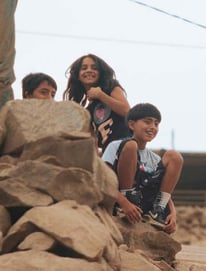 he shouts to Braeden “Bob” O’Brien ’28, with whom he formed a bond the day before. Bob grabs Sandro, lifting and spinning him as he squeals with joy.
Squares of oriented strand board rise with the sun, forming the walls of a new building. Sheets of red metal are unrolled atop wooden beams, darkening the workers below with the day’s first shade. With no shared language but the human experience, American boys and Peruvian men chisel, drill, and hammer a home into existence.
The next day came the final task: hand-mix and lay concrete. My camera captures an assembly line of boys much like the one formed days earlier. This time, instead of water, buckets are filled with gravel and sand transferred from a five-foot mound at the base of the house. Mounds are formed inside, water added, and the boys charged with mixing the gritty mixture. It is long, grueling, sweat-inducing work. Tatiyana and her children stand outside their new home pouring a two-liter bottle of Pepsi into plastic cups. At $3.00 USD, one quarter of the family’s daily wage is being poured out to refresh us.
Once I’ve filmed the labor that will go on for hours, I take my camera through the neighborhood to let this place tell its own story of far-away strangers marching like ants to a hilltop home, clotheslines dancing in a breeze, markers of the place that will leave each one of us changed.
“Building this house is way bigger than giving them a home,” says Nolan. “It’s giving them something to have 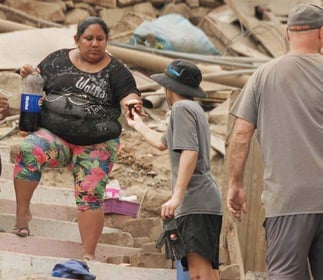 faith in.” “All we did was build a house,” adds Tommy. “They gave us a true gift: relationships. They impacted us more than they probably realize.”
As the construction comes to an end, some boys rest, others play. As though playing on Todesca Field, Rocky Vankoski ’26 swings a stick at stones pitched by Nolan, sending them flying into the mountainous outfield. Sandro squeaks between giggles as Bob spins him headfirst like Superman. Before we leave, Tatiana has something to say; “I want to thank God because one of our dreams is coming true,” she says. “What you boys have done, it signifies the blessings of God, the unity and love that God places into every person. Because of you, we have a home.”
Hours later, the fire pit crackles at our feet as the fifteen of us gather round for one last night. I hear the soft drags and pokes of pencil on paper as the boys continue their journaling. “I’ve never felt closer to God than on these BERSI immersions,” says Rocky, a returning participant who previously attended an immersion in Brownsville, Texas. “Happiness isn’t based on wealth or status, it’s based on how you approach your situations, no matter how hard they may be,” he notes, reading his thoughts aloud from his journal. “Saying goodbye was intense,” reads out Thomas Mahoney ’28. “What stands out to me is that God came for everyone. In America, we can be so focused on ourselves. Here, God is for everyone. I want to always remember that when we’re home.”