
E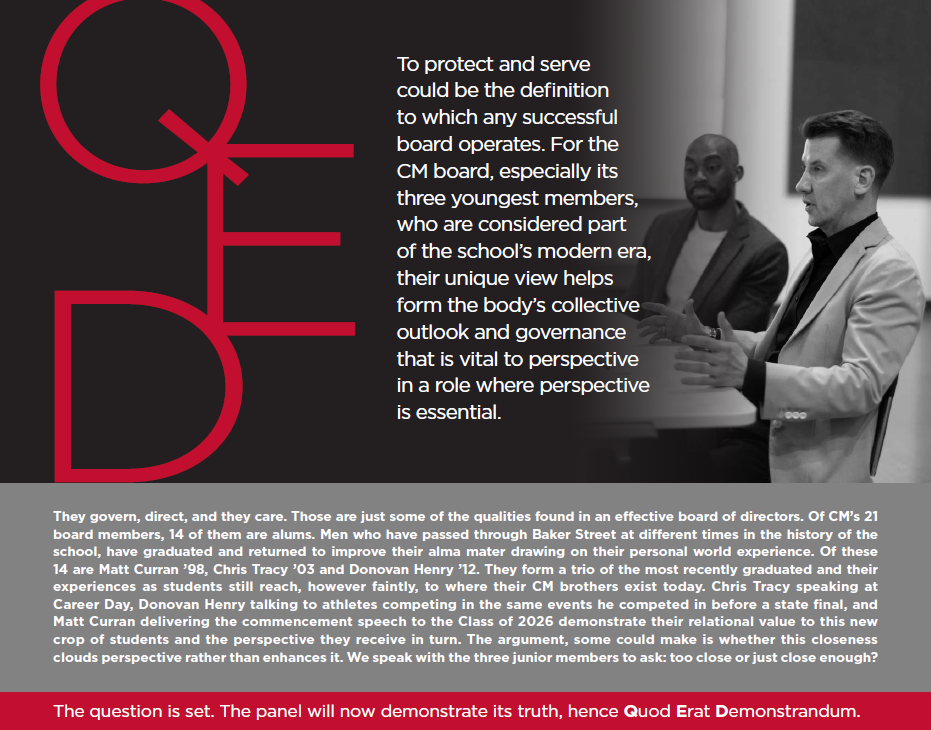
When thinking about the school, planning for the school, and making decisions, is being an alum an advantage?
Donovan Henry: Although the three of us come from different class years, like the other members of the board, CM alumni share a special common bond. Kids still come from the same places…from Boston or the suburbs and that creates this phenomenon that’s tangible every time you meet someone who went here. And on the board that brings us closer as we care for our school.
Matt Curran: I was walking in this afternoon, checking in with the folks at the front office, and I literally said out loud to myself, “The place looks a lot different, but still feels the same.” There are a dozen kids in the front courtyard playing ball…not one screen on, and with the same quick wit and pride in being the scrappy but smart kids we were. It’s a successful brand that if it hadn’t formed us would be harder to make the investment of our time and commitment to serve.
Chris Tracy: We bleed silver and red, and have that in us. I agree the place has changed. The buildings have come along and matured in a great way, but the spirit of this place is very much still the same. But for us to help bring about a sustainable future, we must be the institution’s eyes and ears, which I think is easier to do when you’ve gone here and that picture is still very clear and relevant.
Describe the era in which you attended CM. What was it like?
DH: I could be inflating it, but during my time we accomplished a lot in a variety of ways. Obviously, certain feats by great athletes were made, but our great athletes were also good students. I was proud of our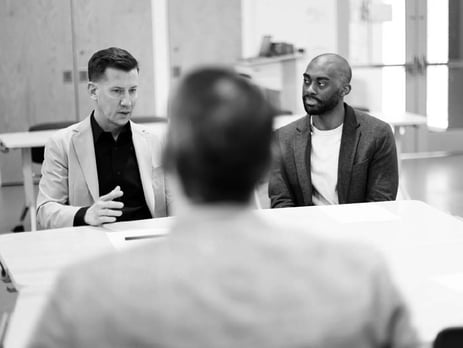 class for having a wide range of accomplishments that fueled others who took note and wanted to do great things too.
class for having a wide range of accomplishments that fueled others who took note and wanted to do great things too.CT: The physical changes where we’re sitting in did not exist when I graduated in 2003. It was Donahue Hall and the narrow hallway in the main building and nothing like it is out back on the athletic fields. But it was the spirit and the relationships I made that were present and have been so important throughout my life which defines my CM experience.
MC: CM in the late ‘90s: successful, gritty, fun. The dances were blowing up, games were well attended and guys were going to good colleges. Check, check, check. You were able to go socialize and do your growing up in a dynamic way, which was really a treasure.
How do you detach yourself from understanding the school that you attended from the one you help make decisions for? How do you remove those “era lenses” and still see clearly?
CT: It can be a hindrance for some. Pigeonholing CM is hard to do, especially today. It just isn’t what a lot of people think it is. If you look at the ‘90s, early 2000s, we were considered a hockey school, but that changed and people’s perspectives need to change with it.
MC: It’s very much an “also” school now. Also, Speech and Debate; also football; also, robotics. And the list goes on and that’s a very proud thing. Maybe we were a one or two-dimensional threat 20 years ago. But parents wanted optionality and the school gave them that. It doesn’t mean we’ve turned away from being great in the things that made us great, but people who return from those past eras see a very different place.
Matt and Donovan, you were part of those championship guzzling, highoctaine teams through hockey and track. Is it easy to dismiss the current version of CM from those gilded ages?
MC: Hard to do when you have a Speech and Debate program like the one we have.
DH: I think President Lewis and school leadership do a great job informing us on what CM is today and how the school is evolving. As members of the board, we are making decisions based on current information and not from our personal experiences. We’re not trying to make it what it was once. It has a life of its own and we base everything we do off that.
While all schools start each academic year with new faces, the sheer diversity of boys from so many different places within the City of Boston and its surrounding areas means that CM is a true reflection of Boston not simply an enclave. By the students who live, learn, and define us, we are Greater Boston. Fair?
DH: CM’s a melting pot and a really accurate representation of the world you’re going to walk out into whether that’s college or whatever professional life you go on to. You’re going to know how to interact with people from all walks of life. And that’s what I’ve really been fortunate to experience, absolutely.
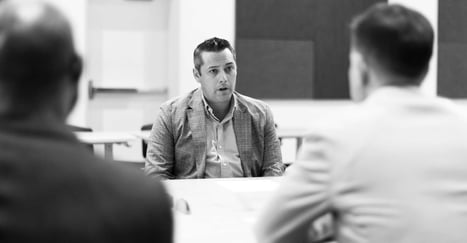 CT: We’re not an ISL school. We serve an awful lot of boys who need financial aid, and we’re very proud of that. We’re not trying to be something we’re not.
MC: One of the things that was so valuable for me, personally, coming from the suburbs, was spending meaningful time interacting with kids from the city, building deep relationships where they spent time with me in the suburbs. That was my social development. There’s something very cool about the City of Boston and to be the best boys’ school in the city of Boston is something that we’re lucky to be.
Should the mission of the school be the highest principle the board should serve and preserve?
MC: Mission only? I think definitely not, and I think that’s one of the things we deliver, which is an outside perspective on and not being singularly focused. We’ve been talking about this recently. How do we make sure we’re thinking about the long-term growth of the school, while refining the mission and the vision. It’s multifaceted.
It seems so very CM to serve. How do you see this in terms of your values of faith?
DH: It’s something that’s ingrained, here—being a servant leader. I feel that’s really what being on the board is. We give our time to discuss the school and make decisions that will impact the future. And so, serving in that way is really just an extension of CM.
MC: I agree. For me, at least, it’s not like this is laborious. Being on the board is a lot of fun. We get to see the best of the best, highly curated, very professionally managed board environment where, yes, we can serve by spending our time, preparing, and contributing financially, but in a way it’s because we love it so much and are personally invested in seeing good outcomes. That’s not hard.
CT: It’s the best job in the world to be able to come here and give back and yeah, they do sort of teach leadership here and being a part of the community. And that in many ways is how I view this. We are paying it forward to the teachers and coaches that did right by us, and we’re hoping is done the same way for these kids and the ones to come.